Stop Wasting Money on Drafty Attics With High-Performance Spray Foam
Stop Wasting Money on Drafty Attics With High-Performance Spray Foam
Stop Wasting Money on Drafty Attics With High-Performance Spray Foam
Imagine standing in your cozy living room on a frigid winter night, perfectly comfortable… while a significant portion of your heating bill is literally floating away through your attic. It’s a frustrating thought, isn’t it? For many homeowners, this isn’t imagination; it’s a harsh reality. A poorly insulated attic is a major energy leak, costing you hundreds, even thousands, of dollars each year. Traditional attic insulation methods, like fiberglass batts or loose-fill cellulose, often fall short, leaving gaps and settling over time. But there's a solution that offers superior performance, long-term savings, and increased home comfort: high-performance spray foam insulation. This isn't just about comfort; it's a smart investment that boosts your home's value and reduces your carbon footprint. Let's dive into why spray foam is the answer to your drafty attic woes and how it can transform your home's energy efficiency.
The Hidden Costs of a Drafty Attic
Before we explore the benefits of spray foam, let’s understand just how much money a drafty attic can be costing you. It’s more than just feeling a chill. The issues stem from heat rising and escaping through the attic, forcing your HVAC system to work overtime. This leads to:
Higher Energy Bills
This is the most obvious cost. When your heating and cooling systems are constantly running to compensate for heat loss or gain, your energy bills skyrocket. The Department of Energy estimates that improper insulation is responsible for a significant percentage of home energy waste.
Reduced HVAC Efficiency & Lifespan
Overworking your HVAC system doesn’t just increase your monthly bills; it also shortens its lifespan. The constant strain leads to more frequent repairs and, eventually, premature replacement – a substantial expense for any homeowner.
Inconsistent Temperatures & Comfort
Drafts create uneven temperatures throughout your home. You might have some rooms that are comfortably warm while others remain cold, leading to discomfort and the need for supplemental heating.
Moisture Problems & Mold Growth
Air leaks often allow moisture to enter the attic, creating a breeding ground for mold and mildew. This can damage your home’s structure, compromise indoor air quality, and lead to costly remediation efforts.
These hidden costs add up quickly, making a seemingly minor issue like a drafty attic a significant financial burden. Addressing it proactively with a solution like spray foam is a wise decision.
Understanding Spray Foam Insulation: A Deep Dive
Spray foam isn't a single product; it comes in two main types: open-cell and closed-cell. Each has its own unique properties and applications. Understanding the difference is crucial for choosing the right option for your attic.
Open-Cell Spray Foam
Open-cell spray foam is softer and less dense than closed-cell. Its cells are not completely closed, allowing air and moisture to penetrate. This makes it a good choice for soundproofing and filling large cavities, but it offers a lower R-value (resistance to heat flow) per inch. It's generally more affordable than closed-cell.
R-Value: Approximately 3.5 - 3.7 per inch.
Cost: Lower than closed-cell.
Applications: Interior walls, soundproofing, filling large spaces.
Closed-Cell Spray Foam
Closed-cell spray foam is much denser and has a higher R-value. Its cells are tightly closed, preventing air and moisture infiltration. This makes it incredibly effective at insulating and adding structural integrity to your roof. It’s also more resistant to mold and mildew. While more expensive upfront, its superior performance often translates to greater long-term savings.
R-Value: Approximately 6.5 - 7.0 per inch.
Cost: Higher than open-cell.
Applications: Attics, exterior walls, crawl spaces, roofs.
How Spray Foam Works: The Science Behind the Savings
Unlike traditional insulation that relies on bulk to resist heat flow, spray foam creates an airtight seal. This is achieved through two main components – polyol and isocyanate – which are mixed at the point of application and expand rapidly, filling every nook and cranny. This eliminates air leaks, convection loops, and conductive heat transfer, resulting in significantly improved energy efficiency. The airtight seal also prevents moisture from entering, reducing the risk of mold and structural damage.
The Benefits of Spray Foam for Attic Insulation
Choosing spray foam for your attic insulation offers a multitude of advantages over traditional methods. Here's a breakdown of the key benefits:
Superior Air Sealing
As mentioned earlier, spray foam’s ability to create an airtight seal is its biggest strength. This drastically reduces air leakage, preventing conditioned air from escaping and unconditioned air from entering.
High R-Value for Maximum Insulation
Closed-cell spray foam, in particular, boasts a very high R-value, meaning it provides exceptional insulation with less material. This is especially beneficial in attics where space can be limited.
Moisture Control & Mold Prevention
The airtight seal prevents moisture from accumulating in the attic, inhibiting mold and mildew growth and protecting your home’s structure.
Increased Roof Stability
Closed-cell spray foam adds structural integrity to your roof, making it more resistant to wind uplift and other weather-related stresses.
Reduced Noise Pollution
Spray foam can help dampen outside noise, creating a quieter and more peaceful indoor environment.
Long-Term Durability & Savings
Spray foam doesn’t settle, sag, or degrade over time like fiberglass or cellulose. This means its insulating properties remain consistent for decades, providing long-term energy savings and reducing the need for replacement.
For marketing small business owners, highlighting these long-term benefits is key to attracting customers who are looking for value and a return on their investment.
Installation Process & Considerations
While DIY insulation projects are tempting, spray foam installation is best left to professionals. It requires specialized equipment, training, and safety precautions. Here’s a general overview of the process:
Preparation
The attic needs to be thoroughly prepared before installation. This includes removing any existing insulation, cleaning the space, and addressing any moisture issues or air leaks.
Application
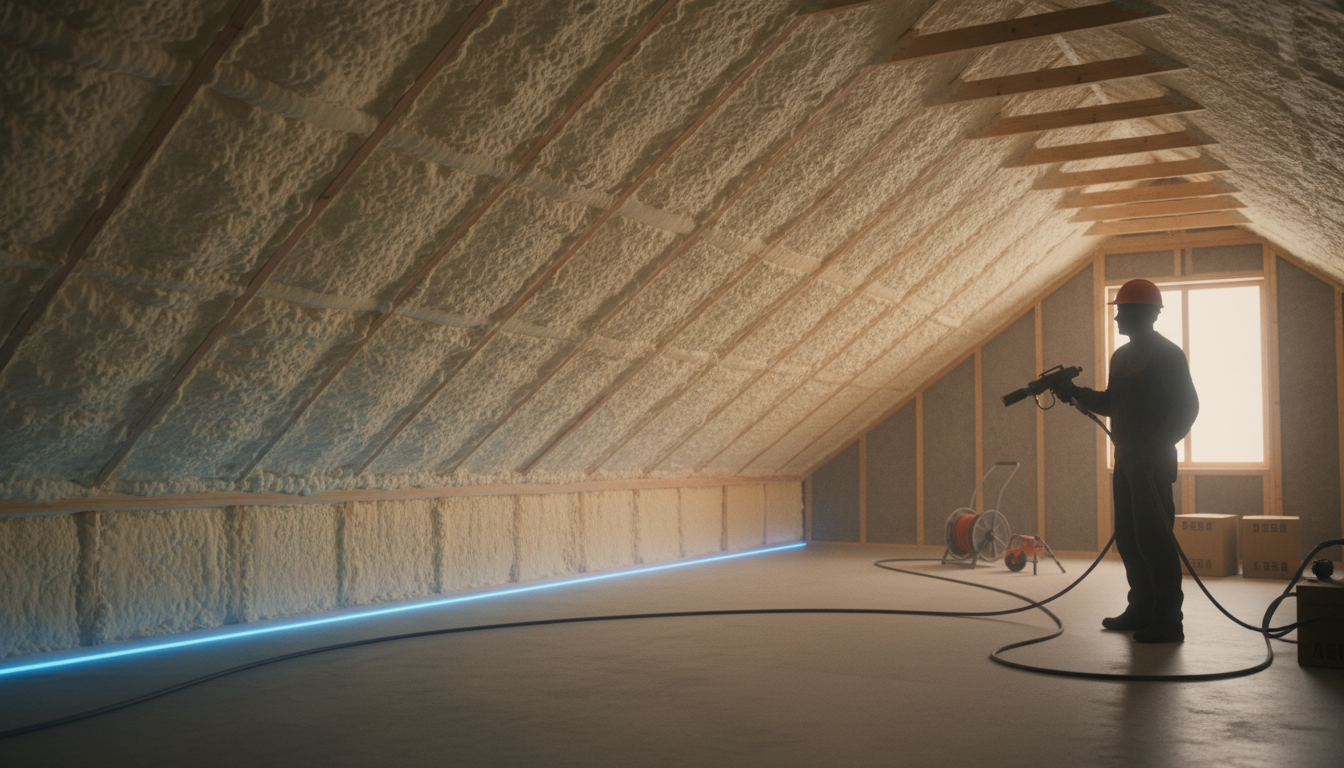
A trained technician will use a specialized sprayer to apply the spray foam, ensuring complete coverage and proper expansion. The foam will quickly harden, creating a seamless, airtight barrier.
Curing & Ventilation
The spray foam needs time to cure properly. The attic should be well-ventilated during this process to remove any fumes.
Important Considerations:
Professional Installation: Crucial for safety and optimal performance.
Ventilation: Proper attic ventilation is still important, even with spray foam.
Safety Gear: Technicians must wear appropriate safety gear, including respirators and protective clothing.
Cost: Spray foam is more expensive upfront than traditional insulation, but the long-term savings often outweigh the initial cost.
Thinking about automating your content creation? Tools for blog automation can help you consistently deliver valuable information to your audience, but remember that quality and expertise are paramount, especially when discussing home improvement projects.
Comparing Spray Foam to Traditional Insulation
Let's directly compare spray foam to some common traditional insulation options:
| Feature | Fiberglass Batts | Cellulose (Loose-Fill) | Spray Foam (Closed-Cell) | |-------------------|-------------------|------------------------|--------------------------| | R-Value (per inch) | 2.2 - 2.7 | 3.1 - 3.7 | 6.5 - 7.0 | | Air Sealing | Poor | Fair | Excellent | | Moisture Control | Poor | Fair | Excellent | | Durability | Limited | Limited | Excellent | | Cost | Low | Moderate | High |
As you can see, spray foam consistently outperforms traditional insulation in key areas like R-value, air sealing, and moisture control. While the initial cost is higher, the long-term benefits and savings make it a worthwhile investment.
Frequently Asked Questions
Q: How long does spray foam insulation last?
A: High-quality spray foam insulation can last for 50 years or more without significant degradation, making it a very durable and long-lasting investment.
Q: Is spray foam insulation environmentally friendly?
A: Modern spray foam formulations are becoming increasingly eco-friendly, with some options using renewable materials and having low VOC emissions. The energy savings it provides also contribute to a smaller carbon footprint.
Q: Will spray foam insulation off-gas?
A: Some off-gassing can occur during the initial curing process, but it typically dissipates quickly with proper ventilation. Look for spray foams with low or zero VOC (volatile organic compounds) for optimal indoor air quality.
Q: Can spray foam be installed over existing insulation?
A: In some cases, yes, but it's generally recommended to remove old insulation first to ensure proper adhesion and prevent moisture problems. A professional assessment is crucial.
Q: How much does spray foam insulation cost?
A: The cost of spray foam insulation varies depending on the type of foam, the size of the attic, and the complexity of the installation. It's typically more expensive than traditional insulation, but the long-term savings can offset the initial cost.
Q: Does spray foam attract pests?
A: Closed-cell spray foam does not attract pests. Some pests may be attracted to the adhesive used during installation, but this is a temporary issue. Proper sealing and preventative measures can minimize this risk.
Investing in high-performance spray foam insulation is a smart move for any homeowner looking to improve energy efficiency, reduce costs, and enhance comfort. Don't continue to throw money away on a drafty attic! Take control of your energy bills and create a more sustainable and comfortable home. Ready to learn more about how spray foam can benefit *your* home?